

Communication is defined as “the imparting or exchanging of information by speaking, writing, or using some other medium”. The most common form of communication is through language whether that is verbal or in the current age digital. It is a skill that we learn from a young age and is deeply ingrained in our ability to remember, giving us context and understanding to allow memories to form. Currently there are over 6500 languages in the world, each developed to have complex methods of understanding and relating to each other.
Peer to peer support is built off communication, telling each other our stories, listening and learning, all to understand our place in this world. How can we support each other if we cannot communicate the feelings and struggles we face? For many, communication doesn’t come as easy. With WHO estimating 16% of the global population as disabled, you can understand there are many people whose communication differs. It is simple to understand a deaf or blind person will communicate in a different manner to the majority. The medical model of disability perceives disabled people as disadvantaged due to their restricted functions in life. But in reality the medical model is far from the fairest view, instead using the social model we can understand that these people are not lacking in function but society is simply not designed for them, leaving disabled people disadvantaged. Imagine a world where everyone was deaf, we would instead have over 6500 versions of sign language, a world that would be designed and built for visual communication
I am disabled, a hidden disability falling under the umbrella of neurodiversity. I am dyslexic and AuDHD (ASD + ADHD = AuDHD). This means my communication style is varied, different and often hard to place in this world. My dyslexia has impacted my ability to improve my depth of understanding in written language. I struggle to enjoy reading due to the mental effort it takes to focus on a book. It has affected the depth of my ability to communicate, leaving me lacking understanding with certain words or phrases – easy readers are people I envy. But my communication also differs in my moods, my approaches and for someone around me this is difficult to understand. When I have energy, my ADHD shines through with a bubbly, interactive and impulsive nature, often trying to direct the conversation. But when low on energy or just simply overwhelmed, my autistic traits are stronger, leaving me with the craving to hide, to be direct (often seen as bluntness) and overall an introverted character that is struggling to be fully present. I love all sides to my communication, I often feel touch and presence are stronger forms of communication than words. But not everyone understands my communication styles.
In CCC sessions we look to create a safe space, a space where all communication is welcomed as long as it follows care and respect for the rest of the group. But creating a space where people can remove their preconceived understandings of how communication should be structured to understand that communication can come in such diverse forms is difficult. As a facilitator, I often fear I may retreat in a situation or bubble loudly over it and this will be perceived in the wrong manner. For me I approach my situation with disclosure, I find it helps most people understand I am going to differ in how I seem, person to person or minute to minute. But there is one area of disability that we can all learn from together. The curb cut effect (or as my mother pointed out that in the uk it is kerb cut – looks slightly less pleasing, yes with dyslexia all my spelling goes off looks) which is when we design for disability we design for a better world. There are so many examples of this as shown in the illustration, from the basic curb cut leading to benefit for the parents with a buggy, the parcel delivery person, the skateboarder or the holiday makers. We see this effect in many places from closed captioning to electric toothbrushes, features that the wider population benefits from but was designed for disability. If we can employ this method of thought throughout our lives that if we are more open and inclusive to diversity, we will exist in a better society.
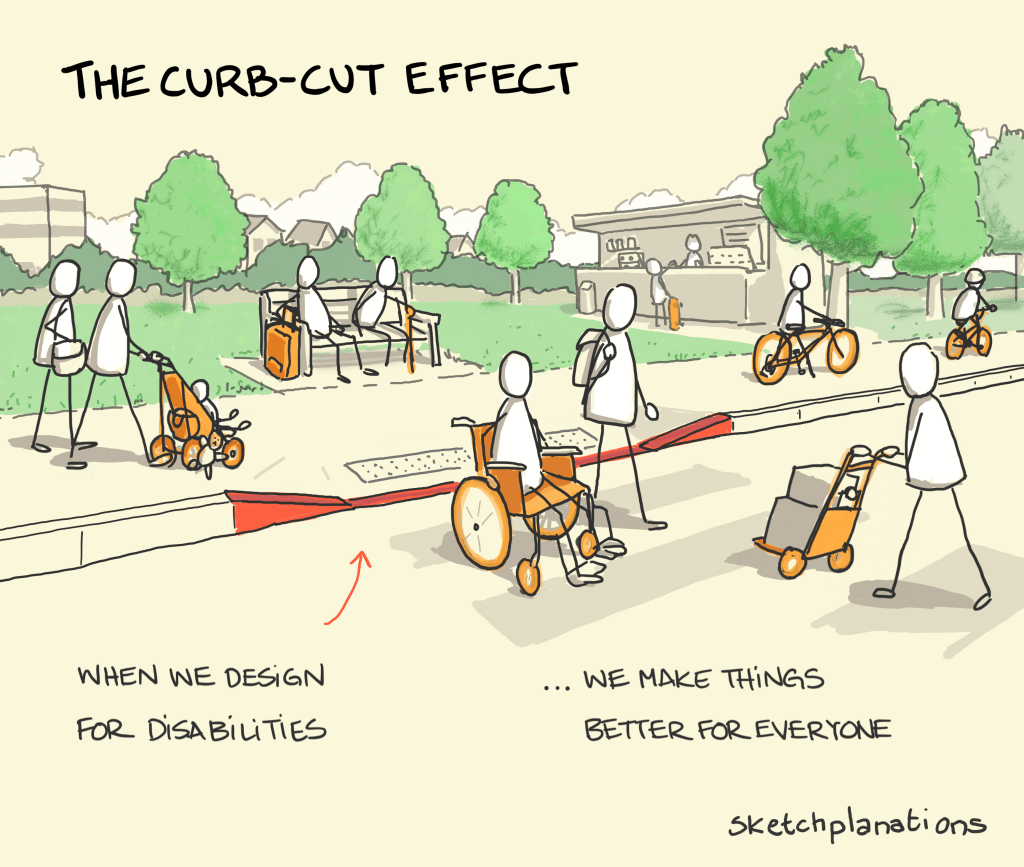
The Curb Cut Effect explained by sketchplanations
Mental health has been for so long excluded from the communication we expose ourselves to daily, especially in men. This week as I write this, it is mens mental health week, in the UK 3/4s of suicides are male. As a population we do not seem to support each other enough and starting a conversation is always the first step. However, sometimes communicating thoughts and feelings can be hard, navigating different relationships from stranger to best friend. In society we spend so much time responding to the question “how are you?” with either “okay” or “fine”, that we have normalised masking our feelings. I feel it is not a burden that others want to carry if I answer with, “I feel shit” – especially at work. But this worry comes from how people may respond to my answer. Have we normalised communicating feelings of sadness in society? Or do we constantly seek to hide them? If we can improve our ability to communicate with each other in ways that don’t cause stress and anxiety, we can support each other through the hard times and normalise that “it’s ok, not to be ok”. However we chose to communicate, we should try to be direct and honest with our feelings, open with our thoughts and to be present. A safe space can facilitate conversations where confidentiality is respected and people can be heard.
How we start the conversation always seems to be the hardest step. But today there are so many beautiful organisations and amazing people supporting this process. Our partner The New Normal, who supports us in training and direction, have started a campaign called A Walk To Nowhere. The campaign challenges you to go for a walk with someone and start a conversation,one that could open a door for either of you. Check in with those around you, and check in with yourself, our health is important both physically and mentally.
Remember you are always welcome to join our conversation, whether that is to listen and learn or share. We can learn to communicate better from the built experiences from the community around us.
 Circular Climbing Collective
Leave a comment